
Estimate the working day
Garden office running costs
Heating is only part of the electricity bill. The worked day adds the heater, computer and other equipment together. Use your own meter readings and tariff to price a day in your office.
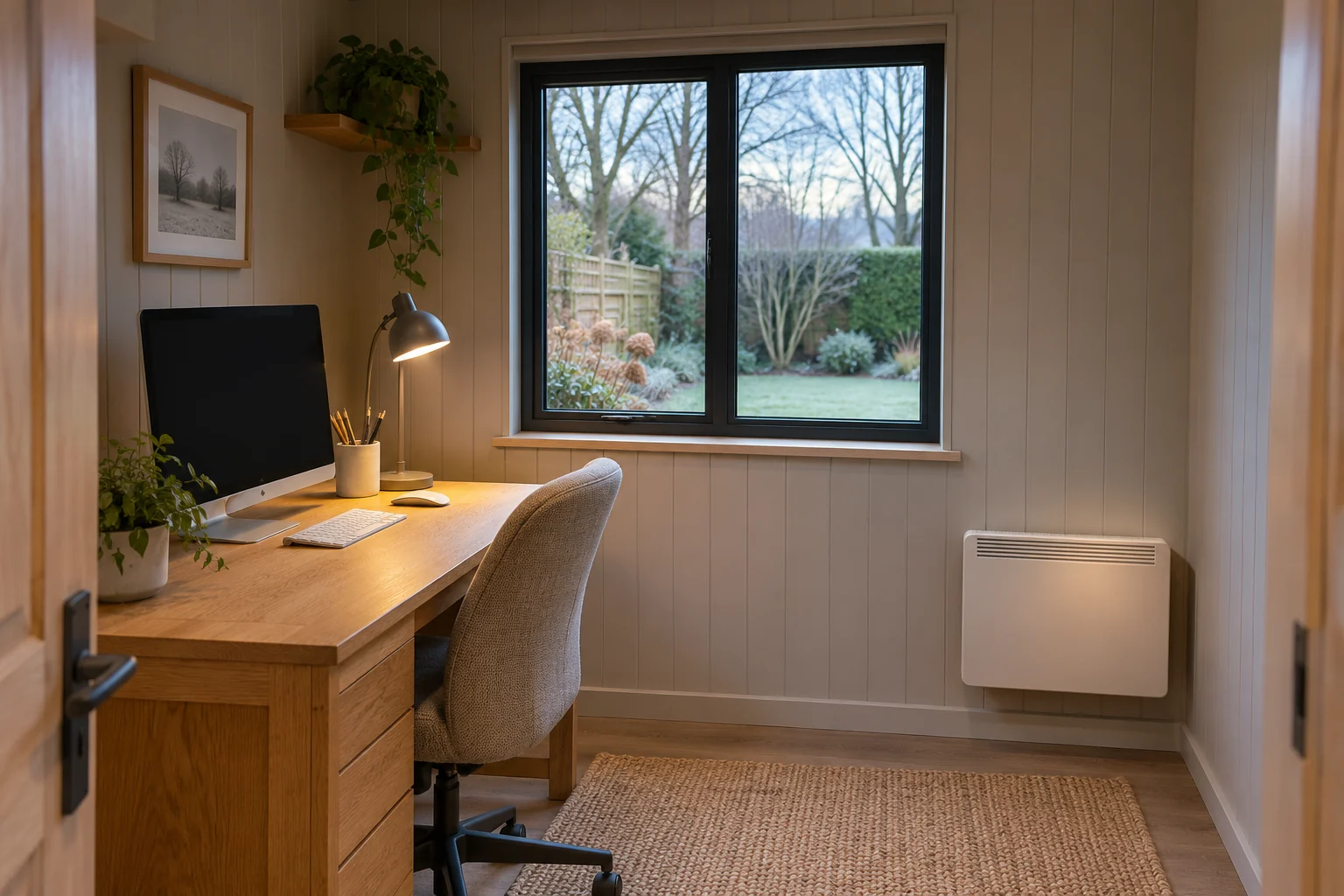
What runs while you’re in the office?
Log the loads and tariff
Enter a measured period when available. Keep assumptions in their own fields, and break the period down by time band if you pay more than one rate.
List heat, IT, lights, network equipment and other appliances. For each, record rated electrical input, measured energy if available, active and standby time, and where the number came from. A manufacturer’s dehumidifier input is quoted at stated conditions. Meaco’s Arete One 12 L, for example, lists 151 W at 20°C and 60% relative humidity. At that input two active hours would use 0.302 kWh. Actual operation depends on the room and settings. The published cold-condition row and an older Meaco brochure differ. The example uses only the 20°C and 60% RH row. If moisture persists, record where and when it appears and ask the appropriate installer or surveyor to investigate the cause. Meaco product table, checked 20 November 2026
Work through energy and cost examples
Heat demand is how much useful heat your room needs in those conditions. The heater’s electrical input rating tells you how much power it draws when running at that rating. For ‘active fraction’, enter the share of the scheduled time it draws the power you’ve assumed. Ask for a room heat-loss assessment if you are sizing equipment.
For a steady input, multiply kW by active hours to get kWh, then multiply by the relevant tariff in pounds per kWh. If equipment cycles, use a measured period or declare the estimated active fraction. For example, a fictional 1.5 kW heater scheduled for eight hours at 50% active time uses 6 kWh. An assumed 100 W workstation for eight hours gives 0.800 kWh and a 10 W light for five hours gives 0.050 kWh. With the separate 0.302 kWh dehumidifier assumption, total is 7.152 kWh.
At 26.32p per kWh, the heater alone uses 6 kWh and costs £1.58 for the day. The whole office uses 7.152 kWh and costs £1.88. The tariff is Ofgem’s illustrative average on default Direct Debit rates in England, Scotland and Wales from 1 October to 31 December 2026. The published rate reflects the temporary VAT removal for that period. Use your own tariff, time bands and date. An existing house standing charge generally belongs to the account, so do not add it again as office use unless a separate supply or new charge is being assessed. Ofgem tariff illustration, rechecked 21 November 2026
What changes if the heater runs for longer?
The table holds the other 1.152 kWh loads and tariff constant. For each row use 1.5 kW, an eight-hour schedule and the stated fictional active fraction. Multiply the unrounded day total by 20 for the defined period.
| Heater active time | Heating kWh | Total kWh | Daily cost | Fictional 20 workdays |
|---|---|---|---|---|
| 25% | 3.000 | 4.152 | £1.09 | £21.86 |
| 50% | 6.000 | 7.152 | £1.88 | £37.65 |
| 75% | 9.000 | 10.152 | £2.67 | £53.44 |
To test a different tariff, replace only the unit price first. For a change to hours, equipment, setpoint or room use, list the inputs you changed and why. Weather, openings, room fabric and occupancy can affect heater operation, so measure a real week where possible using approved equipment and safe methods. Use a competent electrician for any installed monitoring.
Compare one input at a time. At 30p per kWh with the other base assumptions held constant, the 50% example becomes £2.15 per day or £42.91 for 20 days. A different heating schedule or use can change the energy as well as the charge.
Compare other changes using the same base day
These cases change declared assumptions one at a time at 26.32p/kWh. They illustrate the arithmetic. Measure your own conditions to compare real changes.
| Change | Illustrative assumption | Heating electricity (kWh) | Whole-office electricity (kWh) | Whole-office daily cost |
|---|---|---|---|---|
| Shorter workday | Four scheduled hours at 50% active. Workstation and task light run for half as long. Dehumidifier stays at two hours. | 3.000 | 3.727 | £0.98 |
| Lower heat loss after an insulation change | At the same indoor target, weather and hours, assume 35% heater active time. Keep the other loads unchanged. | 4.200 | 5.352 | £1.41 |
| Colder weather | Assume heater active time rises to 75% in the same eight hours. Room, setpoint and other loads stay the same. | 9.000 | 10.152 | £2.67 |
| Changed timer schedule | Assume one less scheduled heating hour at the same 50% active fraction. Comfort and other loads require checking. | 5.250 | 6.402 | £1.69 |
| More useful heat per kWh | Keep 6 kWh useful heat. At a fictional period ratio of 3, a heat pump uses 2 kWh before auxiliary loads. Other loads are unchanged. | 2.000 | 3.152 | £0.83 |
Related guides
Sources and checks
The appliance example comes from Meaco’s product table and the example rate comes from Ofgem. The daily and period costs use declared assumptions and are rounded after each calculation. Use actual operating conditions and your bill for your room.
- Meaco product table, checked 20 November 2026 — Manufacturer power input example of 151 W at 20°C and 60% RH. Checked 21 November 2026.
- Ofgem tariff illustration, rechecked 21 November 2026 — Dated Great Britain default Direct Debit average and temporary electricity VAT treatment. Checked 21 November 2026.
- Undated Meaco Arete One brochure, distributor-hosted — Manufacturer-branded older operating table, page 13. Its 10°C/60% RH row differs from the live manufacturer table, so the cold result is excluded. Checked 21 November 2026.