
CLIENT-FACING ROOMS
Plan the visit from gate to treatment.
Walk from the gate to the treatment chair as a client would. Where would the next person wait, and could they hear a conversation inside? Allow room for the treatment itself, cleaning and access between appointments.
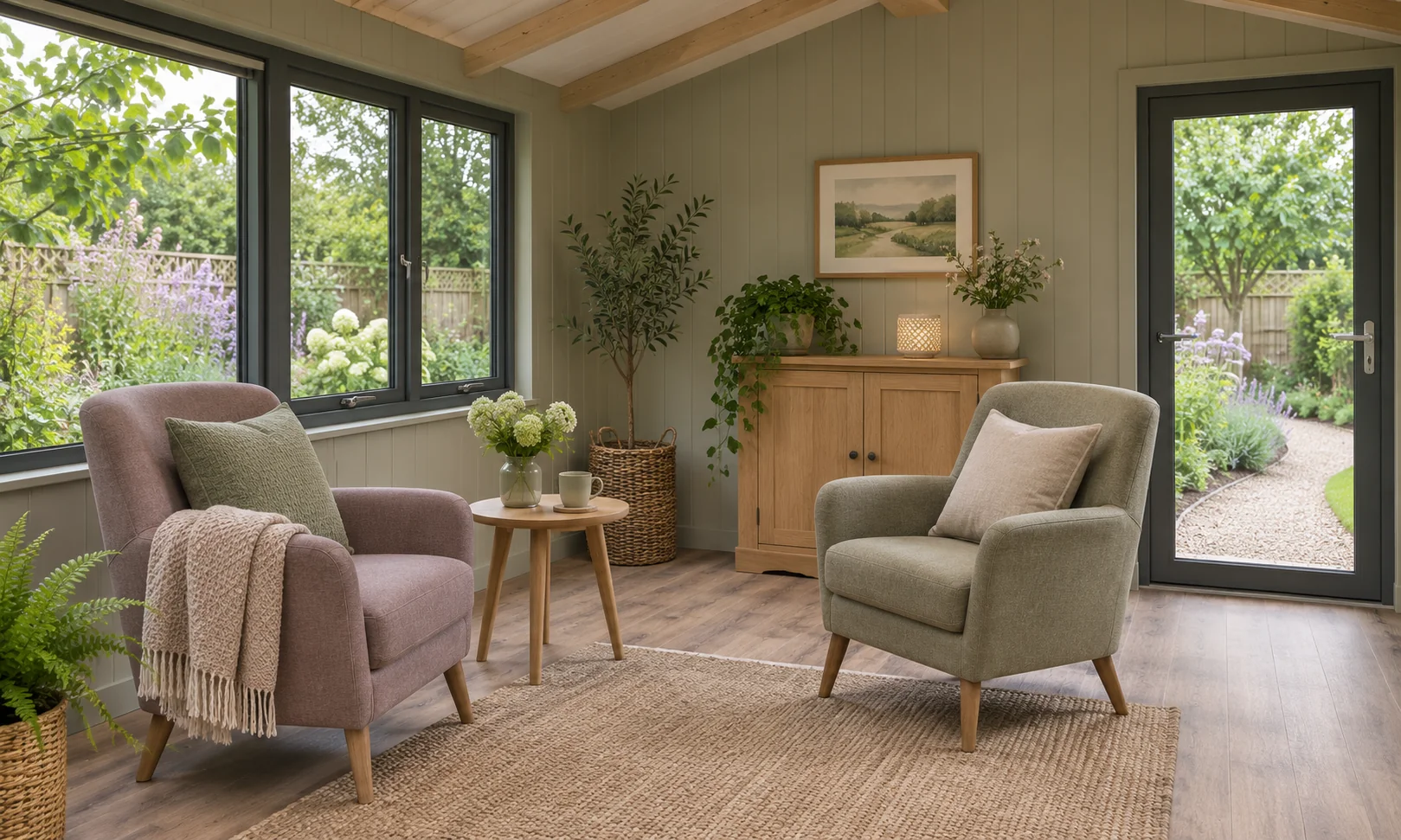
Treatment and salon activities
Counselling can need a discreet arrival and a private conversation. Massage treatment needs a route around the couch, equipment movements and suitable cleaning. For beauty or hair, list the actual products, waste, hot appliances and air requirements. A hair service can involve different substance controls from a talking therapy.
Tell the local authority the hours, staffing, actual treatments and visits. Ask about planning and massage or special-treatment premises licensing for the actual service. Licensing can depend on the council, location and treatment. Check the relevant professional framework separately.
For a salon, brief the designer on occupancy and general room ventilation. Use HSE’s hairdressing COSHH sheet and its exposure-control guidance to have the specific products and processes assessed for capture or other source controls. Agree these separately before ordering.
Client, practitioner and waiting space
Compare two visits
| Use | Internal room size | Try this first |
|---|---|---|
| Talking therapy | 3.60 × 3.00 m | Two arrivals without a confidential conversation carrying. |
| Hands-on treatment | 4.20 × 3.30 m | A transfer, handwashing and practitioner access with the actual couch. |
Try an illustrative talking-therapy room at 3.6 × 3.0 m measured to finished faces: two movable seats, optional third companion seat, private storage and a door clear of seating. For an example treatment room of 4.2 × 3.3 m, draw the couch, working side, cleaning basin position and route around it.
Put the waiting chair where you intend to use it. If one client arrives as another leaves, can they pass each other, and what can each of them see? If the project needs a separate waiting space, put it in the scope and test the onward route.
Plinth Medical’s Model 202 specification gives about 1.88 m couch length. Verify the exact equipment, transfer aid and practitioner clearance. The concepts show an external route to a hypothetical existing WC, and the treatment plan shows a branch to the basin. Agree whether the real route and amenities work for clients.
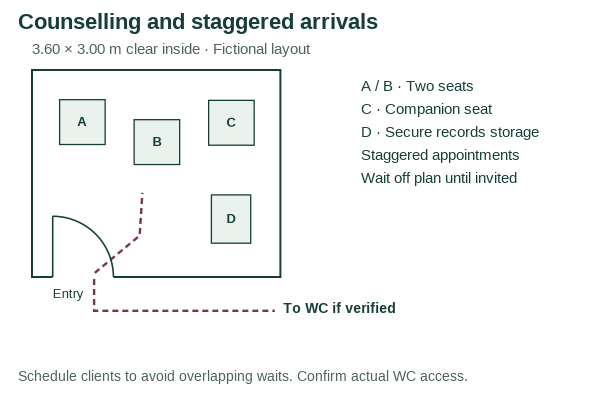
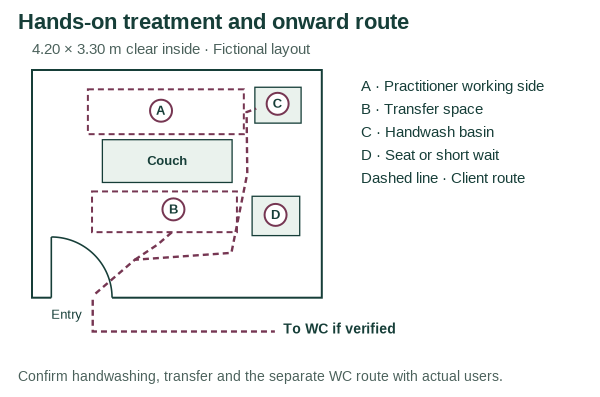
Compare suppliers’ real accounts, such as Garden Affairs’ Somerset treatment room and Green Retreats’ therapy room, as design examples. Our two plans use fictional access and use assumptions.
Confidential conversations and views
Check where speech can be heard as clients approach or pass one another, including at doors, windows and vents. Agree a suitable privacy target with an acoustician where confidentiality is important. For BACP members, the Ethical Framework 2026 applied from 3 November 2026. Check the BACP framework’s confidentiality and records duties for the member’s actual service.
A blind or obscure pane controls sight lines. Sound transmission can travel along other paths. Check typical occupancy and what happens when doors open or the ventilation is operating.
Can clients reach the chair, couch and WC?
Check the complete route from arrival to the client chair or couch, including gate, surface, slope, threshold, clear door opening and manoeuvring space. Record how clients reach a suitable WC and whether any arrangement depends on access through the house.
In Great Britain, service providers’ reasonable adjustment duties apply where needed under the Equality Act. For proposed work in England, ask which Approved Document M guidance applies. For a Northern Ireland service, check Equality Commission Northern Ireland’s accessibility guidance and the separate duties.
Confirm whether your actual service and infection-control requirements need distinct handwashing and treatment or equipment washout facilities. Have the provider and designer agree water, drainage, cleaning and process waste before ordering the room.
Check the proposed accessible route to the WC and from the site entrance with the actual client needs. Confirm distinct handwashing and equipment or treatment washout requirements for the actual process.
Treatment-use brief
Use the same service description for the designer, professional adviser and relevant authority.
Download the treatment-use brief
| Field | Your record |
|---|---|
| Treatment category, staffing and hours | — |
| Client arrival, waiting and departure overlap | — |
| Accessible route and proposed adjustments | — |
| Client WC availability and access route | — |
| Speech privacy test and record handling | — |
| Products, exposure and ventilation | — |
| General air and process source control as separate checks | — |
| Handwashing versus equipment washout and drains | — |
| Exact equipment, working clearance and trade responsibilities | — |
| Authorities, professional body, licensing and written replies | — |
Related guides
Sources and checks
These are different fictional operations. Confirm the actual professional framework, local licensing and design duties. Use selected equipment and a complete route check.
- Garden Affairs: Somerset Linea treatment-room case — Somerset Linea treatment-room case Checked 20 November 2026.
- Green Retreats: West England therapy-room case — West England therapy-room case Checked 20 November 2026.
- Plinth Medical: Model 202 treatment couch — Model 202 treatment couch Checked 21 November 2026.
- BACP: current ethical framework and commencement — current ethical framework and commencement Checked 21 November 2026.
- BACP Ethical Framework for the Counselling Professions 2026 — BACP Ethical Framework for the Counselling Professions 2026 Checked 20 November 2026.
- HSE SR11: hairdressing COSHH essentials — hairdressing COSHH essentials Checked 20 November 2026.
- HSE: controlling hazardous-substance exposure — controlling hazardous-substance exposure Checked 20 November 2026.
- GOV.UK: massage and special-treatment premises licensing — massage and special-treatment premises licensing Checked 21 November 2026.
- GOV.UK: reasonable adjustments for service providers — reasonable adjustments for service providers Checked 20 November 2026.
- Equality Commission NI: accessible goods and services guide — accessible goods and services guide Checked 20 November 2026.
- GOV.UK Approved Document M — GOV.UK Approved Document M Checked 21 November 2026.
- Bristol Water regulations — Bristol Water regulations Checked 20 November 2026.
- Approved Document H 2015 PDF — Approved Document H 2015 PDF Checked 20 November 2026.
- GOV.UK: when permission is required, home working — when permission is required, home working Checked 20 November 2026.