
Specify the whole installation
Garden office heat pumps
Ask for the exact matched equipment, load assessment, fitted price and handover. Compare what the system delivers and what electricity it consumes.
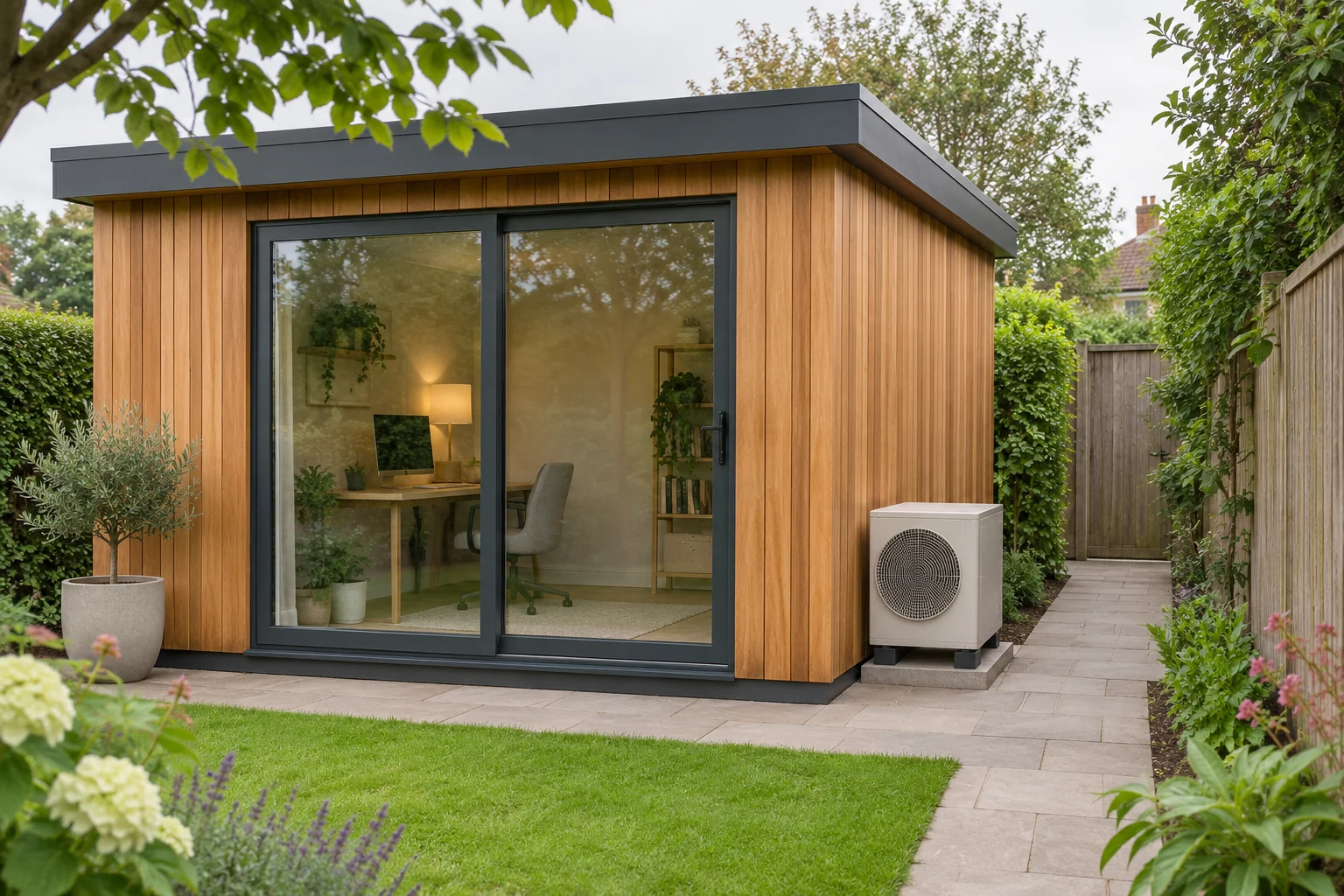
Check whether a heat pump suits the room
- Heating and cooling. Ask about the actual winter and summer loads and indoor air distribution.
- Outside position. Compare noise, clearance for service, water and applicable permissions.
- Fresh air. Keep a separate ventilation plan for the occupied room.
Start with the coldest and hottest hours you expect to use the room, who occupies it and what the sun and equipment add. A fan moves air and a cooling system can remove heat. Check which equipment provides outdoor air to the occupied room in addition to recirculating air. See HSE’s recirculated-air guidance for workplaces. An air-to-air system usually leaves hot water to a separate system. Energy Saving Trust’s guide explains the exception for models designed to heat a cylinder. Ask how warm or cool air will reach your desk, where the outdoor unit could be serviced and how its noise and water discharge affect the site.
In England, the Part 14 Class G permitted development route for qualifying air-source units is conditional. It includes the relevant planning-standard assessment, restrictions on siting and other equipment at the property, and a condition that the unit must not be used solely for cooling. Ask planning and the installer whether all requirements apply and are met for the actual use. Other nations have different rules. For equipment containing F-gas in Great Britain, use the company certification and individual qualifications guidance below to check the particular work. In Northern Ireland, check the separate route under DAERA’s F-gas guidance. England Class G, F-gas companies, F-gas individuals
Price the complete installation
Ask the bidder to draw the indoor and outdoor positions, the connections between them and the routes for water and service access.
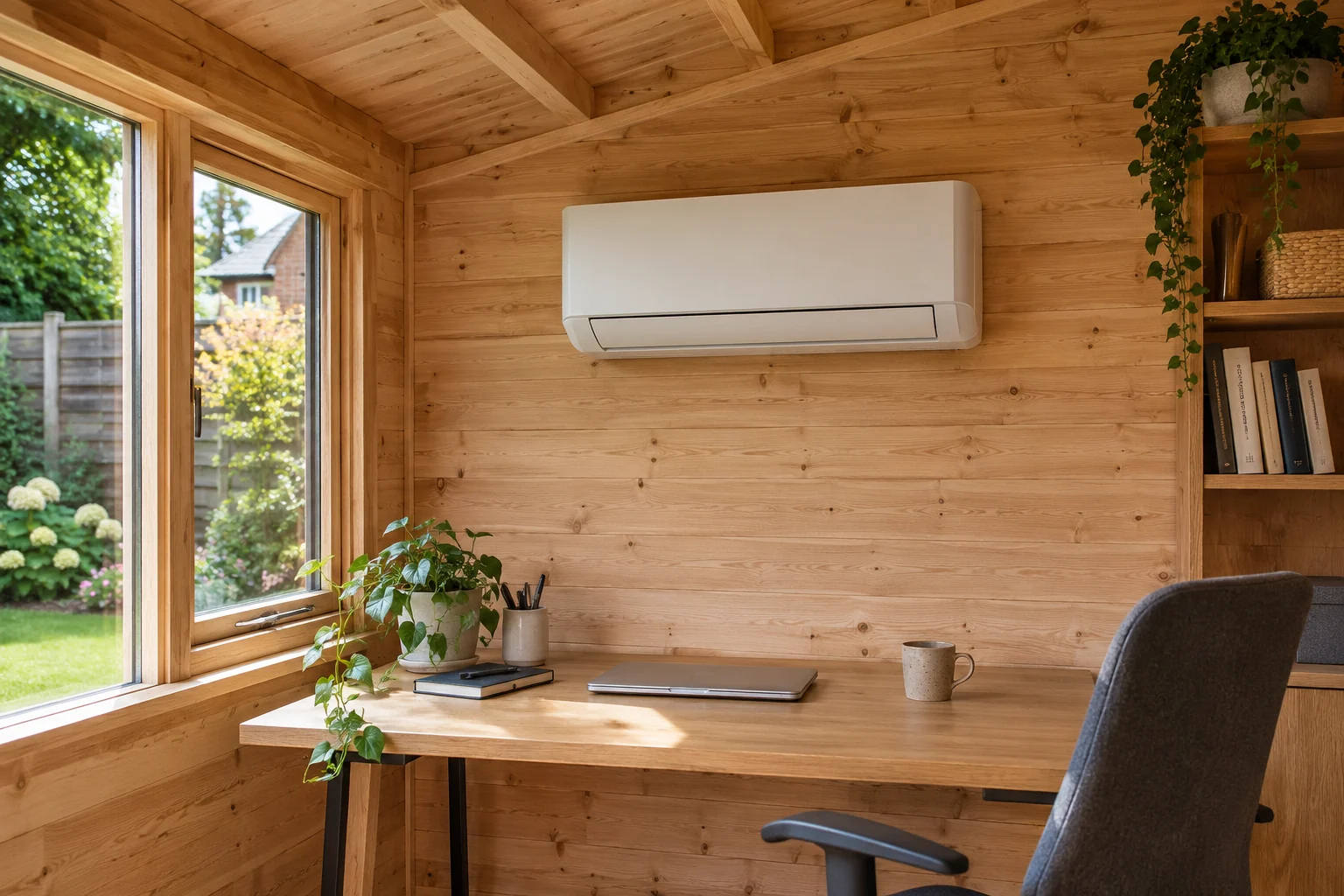
Request the complete fitted scope
Use a fresh copy for each indoor and outdoor unit pair. Ask the bidder to list what the price assumes and which work it excludes.
Ask for a selected system, indoor and outdoor positions, load evidence, mounting, penetrations, pipe routes, supply and electrical changes, condensate and defrost water, noise and approvals, commissioning records, maintenance access and warranty. Confirm each service’s VAT and scope and what counts as nonstandard work. NVK advertises its generic 2.5 kW standard installation from £1,995 including VAT, with up to 3 m of pipe in the stated standard scope. Its separate Comfora banner starts at £2,195. Both listings were checked 21 November 2026. Have the site and actual equipment assessed before relying on a price. Ask a bidder to mark actual pipe, supply and extras on the written quote. NVK installation offer
How much heat do you get for the electricity used?
Compare a real period
Record the weather, exact equipment and which operating mode and auxiliary loads were included.
| Option | Useful outcome | What to record |
|---|---|---|
| Fan | Air movement around people. | Electrical input and active hours. A fan does not remove heat from the room. |
| Direct resistance heat | 6 kWh of useful heat in the simplified example. | At a ratio of 1, 6 kWh electrical input before separate auxiliary loads. |
| Reversible system in cooling mode | Heat removed from the room. | Compare cooling capacity, input and conditions. The illustrative heating calculation does not give cooling consumption. |
| Reversible system in heating mode | 6 kWh of useful heat over the same fictional period. | At the assumed period ratio of 3, 2 kWh electrical input before separate auxiliary loads. |
Compare heat output and electrical input at stated conditions, minimum control behaviour and cooling output, capacity when cold and seasonal figures. For example, Daikin’s table for indoor FTXP25N5V1B and outdoor RXP25N5V1B9 lists 2.50 kW nominal cooling output and 3.00 kW nominal heating output, average-climate SCOP 4.61 and SEER 7.20. Daikin’s nominal heating test uses 20°C dry-bulb indoors and 7°C dry-bulb and 6°C wet-bulb outdoors. Its nominal cooling test uses 27°C dry-bulb and 19°C wet-bulb indoors and 35°C dry-bulb outdoors. Both use an equivalent 5 m pipe run and no level difference. These output ratings describe useful heat delivered or removed. Ask separately for electrical input. Ask which climate and conditions apply and how defrost, cycling or standby are represented. Daikin matched product table, checked 20 November 2026
For illustration, compare two fictional arrangements delivering 6 kWh of useful heat over the same period. If the first uses direct resistance with a simplified output/input ratio of 1, it uses 6 kWh. If the second achieves an assumed period ratio of 3, it uses 2 kWh, before separately recorded auxiliary loads. The example shows how to interpret a ratio. Use actual selected equipment, operating conditions and measured time for a bill estimate.
COP describes useful heat output divided by input under stated conditions. SCOP describes heating over a standard season, and SEER is the seasonal cooling efficiency measure. These are different conditions and time bases. Ask how matched figures relate to the hours, weather and settings you expect, then compare measured consumption over your own period.
Related guides
Sources and checks
The sources cover three separate questions: how the equipment performs, what the dated installation offer includes and which planning route may apply in England. An installer and applicable planning authority establish project-specific fit, cost and approvals.
- England Class G — England Class G conditions, including MCS planning standard and G.3(aa) cooling-only restriction. Checked 21 November 2026.
- F-gas companies — Company certification for applicable equipment and work. Checked 21 November 2026.
- F-gas individuals — Individual F-gas qualifications for relevant tasks. Checked 21 November 2026.
- NVK installation offer — Dated VAT-inclusive standard starting price and stated pipework boundary. Checked 21 November 2026.
- Daikin matched product table, checked 20 November 2026 — Nominal output and seasonal performance for the exact matched models. Checked 21 November 2026.
- HSE guidance on recirculated and fresh air — Workplace outdoor air provision alongside recirculation. Checked 21 November 2026.
- Energy Saving Trust air-to-air heat-pump guidance — Heating and cooling of indoor air and usual separate domestic hot-water provision, with model-specific exceptions. Checked 21 November 2026.
- DAERA Northern Ireland F-gas guidance — Separate Northern Ireland regulation and qualification context for people and companies. Checked 21 November 2026.