
CEDAR WEATHERING
Track how your cedar changes.
Compare the same elevation over time, record its finish and exposure, and investigate marks that keep coming back.
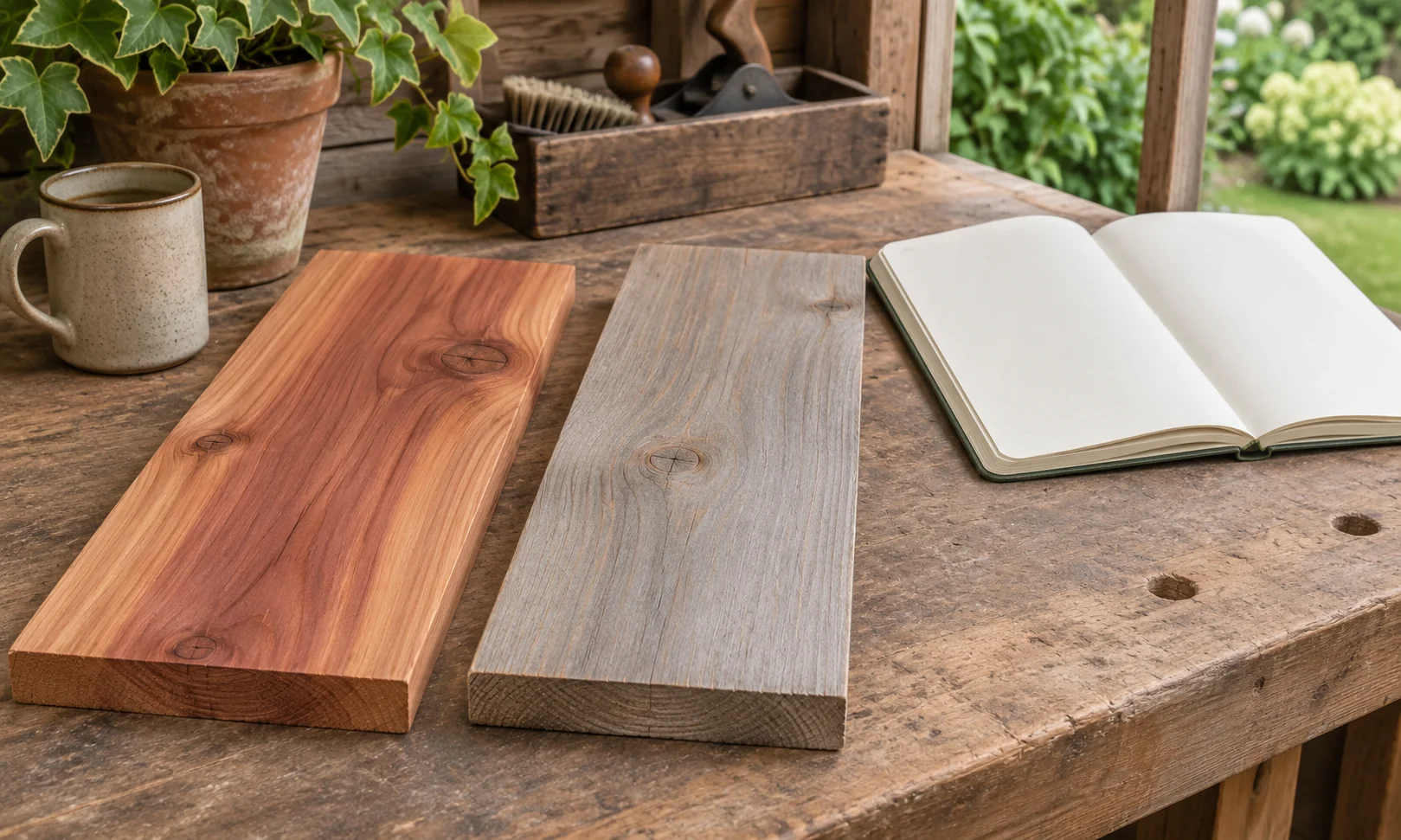
Why one cedar wall can grey faster than another
Exposed cedar can grey as sunlight and moisture weather the surface. Different elevations can change at different rates. Compare a sheltered return with an exposed face, while noting time of day, rain and any finish before drawing a conclusion.
Broad silvering belongs in the appearance record. A local mark near a leaking outlet, coating failure or a persistent wet patch raises different questions. Photograph the wider elevation and the detail and ask the installer to identify what finish and care method applies.
For western red cedar, the WRCLA finishing guide explains how exposure affects surface colour. Record change by elevation. Ask for investigation where water entry or failure is suspected.
See how coated cedar changed in one field trial
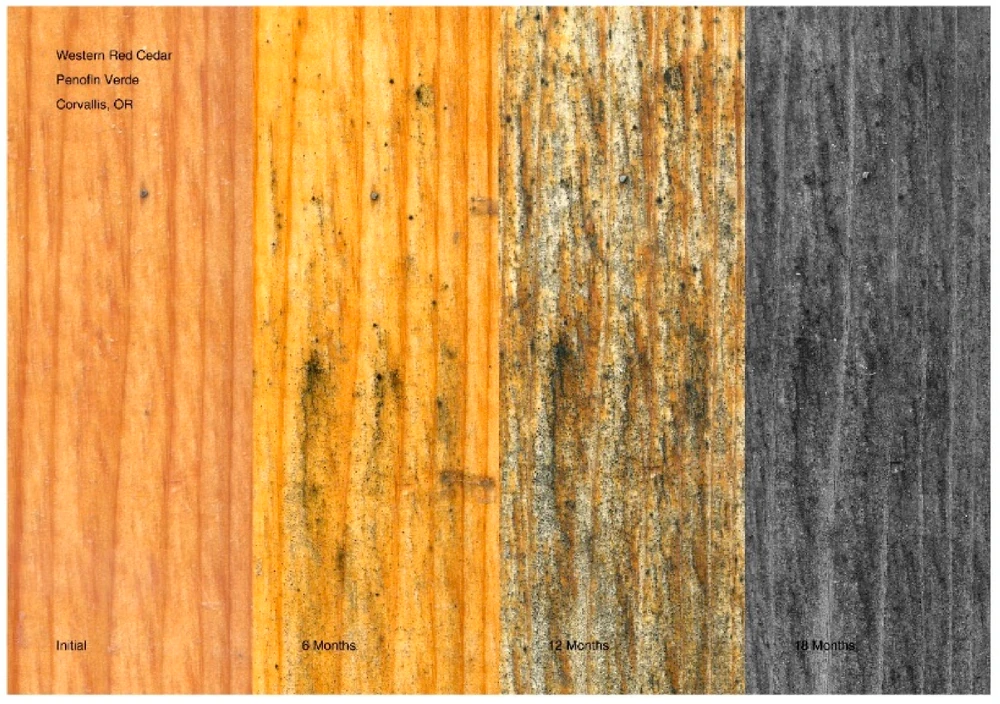
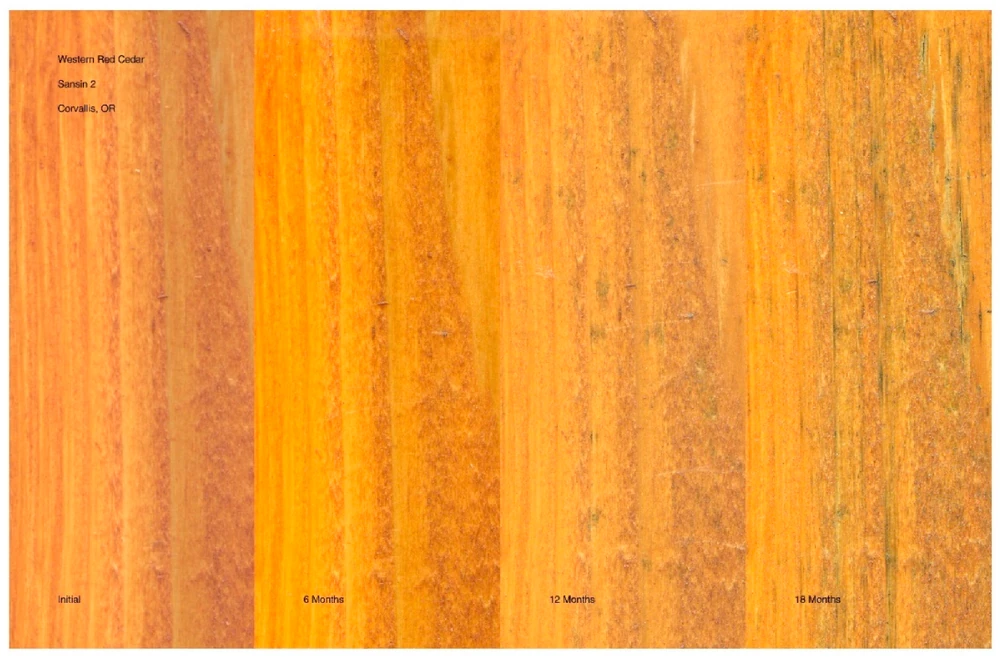
In a 2021 study at Oregon State University’s Peavy Arboretum near Corvallis, Oregon, the researchers exposed coated western red cedar specimens outdoors. The broad faces in the trial were mounted at 45° facing south. Each row follows one coated specimen, scanned before outdoor exposure and again after 6, 12 and 18 months.
The two rows show different specimens and named coatings. Use the comparison to see how appearance can vary under one exposure. The trial included coated specimens. For your own building, record the finish and orientation of each elevation and check its condition on site.
Compare care and finish options
Decide whether you’re happy for the cedar to change colour or want to maintain a particular finish. Identify product name, past coatings and condition first. Named oil products have their own substrate, preparation and re-coating requirements. A UV-protection product can delay visual change while a finish remains maintained.
Try any supplier-approved process on a sample or inconspicuous area first. Keep the written care instructions, colour reference and warranty conditions with the record for that wall. Get advice if you cannot identify the previous finish or the mark keeps returning.
Check the current Osmo UK UV Protection Oil Extra instructions for its compatible substrates, preparation and renewal. A maintained coating can slow the appearance change. Record the actual finish used on the room.
What to record when you check the cedar
Inspect from reachable positions. Repeat a photo at the same distance and similar light. Include drips, edges and openings in the description, but give the person inspecting the building the chance to establish the cause.
For new cladding, start with dated photos at handover and ask the installer when to review each face. A documented series needs the same project, dated exposures and permission to share.
Cedar care record
Pick a repeat photo position and write down earlier treatments so another person can interpret the change.
Download the cedar care record
| Field | Your record |
|---|---|
| Elevation and compass orientation | — |
| Date, lighting, weather and photograph reference | — |
| Species, finish and known coating history | — |
| Named care guide and version | — |
| Location, area and extent of change | — |
| Moisture, outlet and overflow observations | — |
| Action, person responsible and next assessment | — |
Related guides
Sources and checks
WRCLA guidance describes western red cedar. Osmo’s preparation and care requirements apply to its named product. Use the care guide for the ordered finish and the actual exposure. The study images show coated samples on an Oregon test rack. They illustrate changes observed in the experiment.
- WRCLA Real Cedar: finishing western red cedar siding — finishing western red cedar siding Checked 21 November 2026.
- WRCLA Real Cedar: siding care and maintenance — siding care and maintenance Checked 20 November 2026.
- Osmo UK: UV Protection Oil Extra product instructions — UV Protection Oil Extra product instructions Checked 21 November 2026.
- Davis, Leavengood and Morrell · Performance of Exterior Wood Coatings in Temperate Climates — The materials and methods give the scan intervals and test-rack orientation. Figures 17 and 18 show different coated western red cedar specimens under the same field-trial conditions. Checked 21 November 2026.