Included
The selected package expressly contains the work or item.
What to retain: The specification, quantity or allowance and conditions. Do not add the same included item to the subtotal again.

Keep the price beside its evidence.
When you see a starting price, check which room it buys and which jobs it leaves to you. Our comparisons show the supplier’s published terms and flag the details you’ll still need in writing for your plot.
Use the same scope item across offers so that different descriptions don’t hide missing work.
We select identifiable suppliers and relevant models or ranges with public evidence that helps explain the buying question. An example may still have an unknown size basis, VAT position or inclusion; that gap must stay visible. Inclusion is not proof that all details are verified or that the offer meets your particular brief.
The office comparison uses a small selection of compact and entry-range offers to expose scope differences. The cost guide separates published packages from project costs. The Bristol shortlist is alphabetical and cites advertised coverage. These selections are not the whole market or a price-to-quality ranking.
Read a comparison with these questions beside it. An unanswered point becomes a question for the selected supplier, not an assumed inclusion.
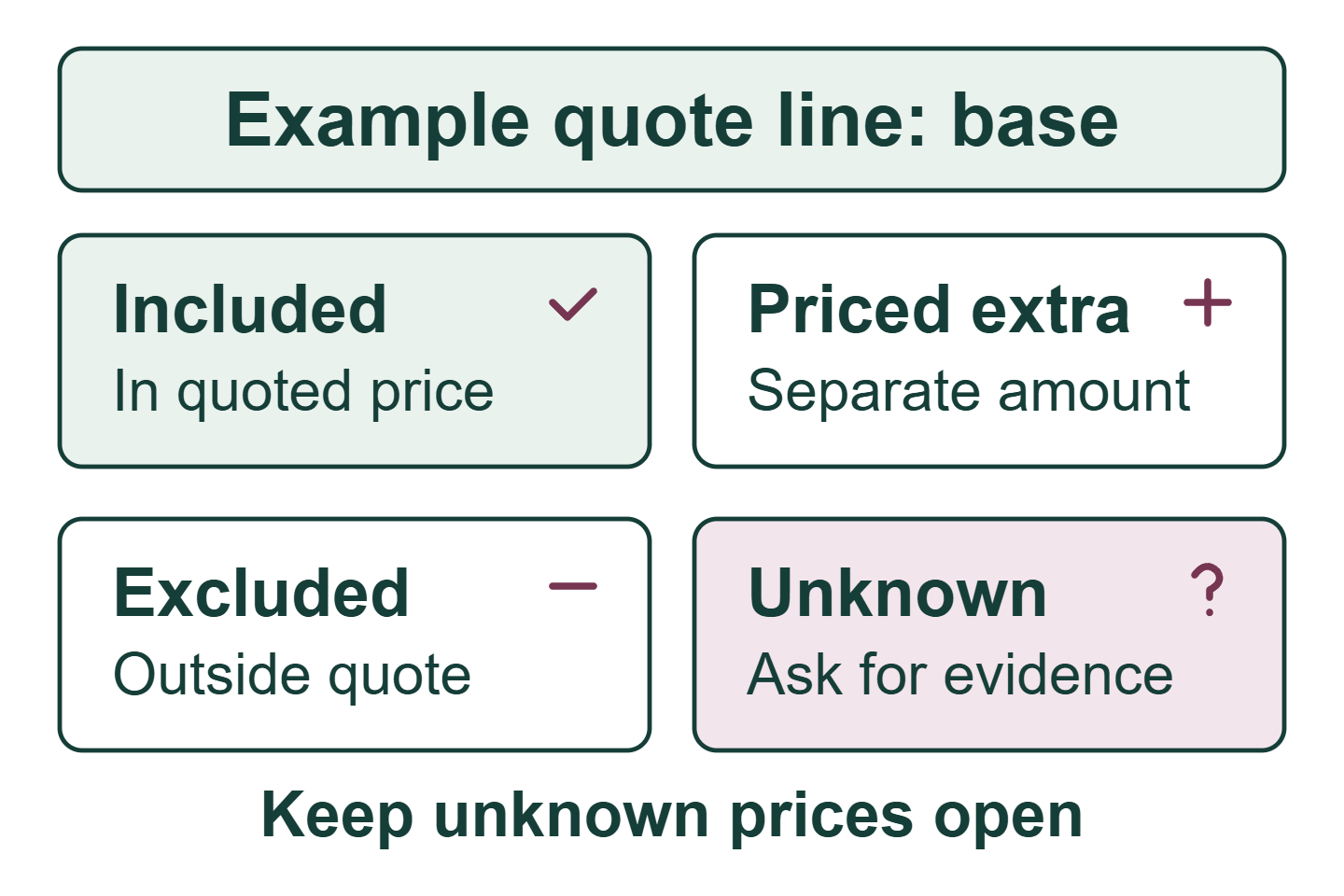
Four statuses — each needs a source or an explicit question.
The selected package expressly contains the work or item.
What to retain: The specification, quantity or allowance and conditions. Do not add the same included item to the subtotal again.
A separately stated amount covers a defined addition.
What to retain: Its VAT basis, scope and whether the price is fixed, provisional or subject to survey.
The work is outside that supplier’s quoted package.
What to retain: If your project needs it, identify who will do and price it. Excluded does not mean unnecessary.
The selected evidence does not establish the scope or price.
What to retain: The question, source gap and next confirmation needed. A blank is not £0.
Unpriced explains a missing amount; unclear explains uncertain scope; conflicting sources means two statements disagree. Use these as qualifications to the record. They are not scores and do not turn missing information into an included item.
Assume two invented offers have matching finished internal space and the same other required work, with all amounts including VAT. Offer A is £12,000, but its required house connection is unpriced. Offer B is £12,500 and includes the matching connection.
The headline difference is £500. A’s known subtotal remains £12,000; its comparable final total is unresolved. Treating the missing connection as £0 would manufacture a saving. Obtain the connection scope and price before comparing final totals. This example demonstrates the method; it is not a supplier offer, market estimate or assessment of quality.
For the actual paired budget record, use the quote-comparison guide and its A/B worksheet. It keeps supplier amounts, buyer allowances, responsibility and evidence separate.
Checked on 20 November 2026, Little Green Rooms’ price guide states a 30-metre allowance for its standard house connection, while its FAQ states 40 metres. These are supplier scope statements, not cable-design instructions. We have not resolved the discrepancy with the supplier. Preserve the source-specific conditions and ask which applies to the selected written quotation; do not choose the more generous allowance by assumption.
Our comparisons are desk research. We have not inspected the buildings, tested their performance or obtained matched quotations for your plot. Supplier-hosted testimonials and supplier-reported projects retain that attribution. We do not convert them into an independent inspection, star score or endorsement.
The check date tells you when we saw the offer. Ask the supplier whether it’s still available. Recheck the chosen model, scope, VAT basis and current terms before relying on a price. A new offer should not inherit an old configuration’s inclusions without evidence.
If you find an outdated offer or conflicting document, prepare the comparison-page address, exact line, supplier-source links and dates using the Contact and corrections template. Verify the source, revise the affected scope or price, and recheck any dependent arithmetic and explanation. Keep unresolved fields open. The editorial policy describes the wider evidence and correction process.
Garden Building Guide publishes these comparisons. Inclusion does not mean a supplier has approved this guide or that we have inspected its workmanship. No approved supplier referral agreement or issued code is recorded; any future paid relationship would be disclosed in the affected content before its referral route is used. The correction template prepares an unsent evidence record.
Last reviewed: 24 November 2026. Review this method when the comparisons, evidence standards, publisher, contact route or commercial arrangements change. Preparing a correction report does not submit it or request a supplier quotation.
Check the current commercial status and any recorded supplier relationships.
Read the commercial disclosureRead the implemented data flows, browser controls and publisher/contact status.
Read the privacy informationPublication wording was checked on 24 November 2026. The office, cost and Bristol comparisons, quote worksheet and source-specific checks retain their stated dates. The two-offer example is fictional, with matched-scope and VAT-inclusive assumptions stated. No product inspection, performance test, personalised quotation, rating system or supplier approval is claimed.